Monday, March 30, 2009

Obama's No Socialist. I Should Know.

This question that keeps popping up about Barack Obama being a socialist is very interesting and it is a question that Barack Obama should answer for himself.

I disagree with many positions of the Socialist Party and often wonder if the Socialist Party understands what socialism is all about; but, I don't say "Billy Wharton's No Socialist. I Should Know." Because Billy Wharton can speak for himself.

Fox News called out Sam Webb, the nominal head be default of the Communist Party USA, to make the exact same assertion about Barack Obama... and Webb dutifully said the same thing for Rupert Murdoch who supported Obama--- that Obama is no socialist.

Since Sam Webb claims he wants no association with "20th Century socialism," I can assume that Sam Webb is no socialist, either; and that he wouldn't know a socialist if he met one... so, he couldn't possibly know whether or not Barack Obama is a socialist. Why the heck is Webb even speaking for Obama? Could it be that Webb and Obama really do share a common ideology?

So, how would Webb or Wharton know if Barack Obama was a socialist or not--- either an open socialist or a closet socialist... after all, the socialist New Party did endorse Barack Obama when he ran for public office in Illinois... and, Barack Obama came to a New Party meeting to personally accept the endorsement--- there are even pictures of this... we all remember the billboards along our highways put up by the John Birch Society--- Martin Luther King sitting next to the communist with a big red circle around him.

And many members of the Socialist Party did endorse, and vote for, Obama over their own candidate.

And the National Board of the Communist Party USA, Chaired by Sam Webb, did--- unfortunately--- endorse Barack Obama... they even turned out en masse clapping and cheering for Obama's inauguration ceremony; perhaps invited by Obama himself?

Obviously we can carry this question of "is, or isn't, Obama a socialist" to the absurd extremes, which the right-wing has, and is, doing.

We all know that the real reason this question has even arisen is due to anti-communist "red-baiting." Red-baiting is a favorite past time of the over-paid pea-brained, capitalist sooth-Sayers when they aren't busy creating their next big lie explaining to us how great capitalism is.

The so-called "leaders" of the Communist Party USA even claim that John Maynard Keynes was "a great socialist economist."

Now, are we all going to start asking, again, "Is Obama a socialist" because he supports a bastardized neo-liberal Keynesian approach to economics?

There is good reason to suspect that Barack Obama has a very good grasp of what socialism is because he had one the very best teachers, Frank Marshall Davis--- who I am sure schooled the young Barack Obama well in Marxist-Leninist ideology. But, does this mean Barack Obama is a socialist?

In fact, just about every graduate from Harvard University's School of Business receives the best Marxist education money can buy... how many of the graduates are communists or socialists? If we are lucky, maybe a handful.

I have met socialists and communists who had less of an understanding about what socialism is than Barack Obama--- Sam Webb is one such person; that he would be stupid enough to go on national television and answer a question meant for Barack Obama, a question only Barack Obama should be asked--- without himself knowing what socialism is--- proves my point. Talk about the stupid trying to lead a dumb donkey!

Actually, Obama demonstrated a pretty good grasp of socialist thinking, and practice, when he asked in response to the taunts from the right-wing something to the effect: "Am I a socialist now because I might have shared my peanut butter and jelly sandwich with a kid in grade school?"

I kind of doubt Barack Obama ever shared anything with anyone seeing as how he is nothing but a self-serving, self-promoting opportunist politician who only cares about himself to the exclusion of everyone else.

I have known a number of socialists and communists just like him... so, I think he just might be some kind of socialist or communist... but, I'm not about to call him "comrade." If he had been a communist or socialist before, "sell out" would be the more appropriate word now.

Is Obama a socialist or communist? Let this dumb donkey Obama answer this stupid question himself.

Socialists and communists shouldn't be concerned with this question in the least... what we should be concerned about is stopping the three wars raging in Iraq, Afghanistan and Pakistan and halting all further support and financial assistance to the Israeli killing machine and slashing the senseless military budget so we can solve the real problems people are experiencing.

I haven't seen Sam Webb or Billy Wharton addressing the problems of working people here in Minnesota, or anyplace else for that matter... they have been silent on the closing of the St. Paul Ford Twin Cities Assembly Plant as two-thousand jobs are about to be flushed down the Mississippi and chopped up like suckers passing through the turbines of the hydro-dam which has powered this plant for over 80 years--- compliments of tax-payers.

Where is the call by Webb or Billy Bob Wharton for public ownership of this plant?

What the heck, they were even silent when their support was needed for SF 607, a piece of legislation brought forward by a few progressive Minnesota state legislators... and, then, where do "Communist" Sam Webb and "Socialist" Billy Wharton stand on a "people's bailout;" we didn't see hide nor hair of them when the same Minnesota state legislators brought forward the Minnesota People's Bailout to try to protect workers like the Ford workers losing their jobs.

Two-million casino workers employed in the Indian Gaming Industry at over 350 casino/resort/hotel/motel/restaurant/theme parks spread out across the country using "Compacts" to establish right-to-work for less without any rights colonies sending these two-million workers to jobs in smoke-filled places of employment without any rights under state or federal labor laws... the most Draconian working conditions in the world where these two-million workers are directly under the thumbs of outright gangsters and mobsters who bust into the homes of workers and beat them with baseball bats and steel pipes until their heads swell to the size of a basketball--- not a peep from Sam Webb or Billy Wharton.

Sam Webb and Billy Bob Wharton both can wax as eloquently as John Sweeney--- that Methodist preacher passing himself off as a labor leader--- about the Employee Free Choice Act; but, none of them have the courage to stand up and call for repealing the repressive "At-will hiring; at-will firing" legislation on the books in twenty-eight states--- in fact, none of them are even aware that this Draconian legislation is the major impediment to union organizing in the United States today; a hurdle not even the Employee Free Choice Act will be able to jump.

The real question here is not about whether Barack Obama is a socialist or communist.

The real question here isn't even whether or not Sam Webb and Billy Wharton are Communists and Socialists, respectively--- because we know Billy Wharton doesn't want to be called a Communist and Sam Webb has already stated he wants it known that he completely disassociates himself from 20th Century socialism.

The one and only issue involved in this question being asked as far as if Barack Obama is a socialist or communist is this:

Is the American working class going to tell these anti-communists to take their red-baiting and shove it where the sun doesn't shine?

All I got to say is that if with capitalism on the skids to oblivion dragging the rest of us along with it down the road to perdition; if the working class in the United States doesn't give red-baiting the boot and get up to speed real quick-like about what socialism is all about, we are in for some very rough times.

We might all be socialists now, but, are we all prepared to struggle for socialism to save out butts?

A little suggestion for Sam Webb, Billy Wharton and Barack Obama: If American workers start learning about the socialist alternative to capitalism from real communists like Marx, Engels, Lenin, William Z. Foster, James W. Ford, Earl Browder, Wyndham Mortimer, Elizabeth Gurley Flynn, Paul Robeson, Gus Hall, W.E.B. DuBois and Henry Winston, they might want to begin looking to see where they can find a safe haven because there are going to be some mighty angry workers in the good old U.S.A. And if I were them I would forget about those sandy beaches in the Cayman Islands.

It is nice that "Communist" Sam Webb and "Socialist" Billy Bob Wharton are sparring with Rupert Murdoch's boys; but, they might want to consider taking part in the real class struggle on the side of the working class against Barack Obama and his Wall Street crowd who are laughing like hell all the way to their banks in the Cayman Islands to deposit our tax-dollars and the profits they extract from our hides.

And while we are talking about what makes a socialist or communist we should consider where people stand in regard to imperialism.

Imperialism, U.S. imperialism in particular, is taking a heavy toll on working people, and humanity in general.

There are the obvious victims dying and wounded in these dirty imperialist wars.

Rather than acknowledging that "we are all socialists now," with so few people understanding what socialism is... maybe we should consider that most of us are all "victims of imperialism now" because the United States has over 800 military bases on foreign soil dotting the globe when we should have 800 public health care centers spread out across the United States providing free health care for all.

I think if we can get up to speed with a quick lesson on imperialism, we will be ready for "Socialism 101" in short order.

Alan L. Maki


Obama's No Socialist. I Should Know.

http://www.washingtonpost.com/wp-dyn/content/article/2009/03/13/AR2009031301899.html

By Billy Wharton
Sunday, March 15, 2009; Page B01

It took a massive global financial crisis, a failed military adventure and a popular repudiation of the Republican Party to make my national television debut possible. After 15 years of socialist political organizing -- everything from licking envelopes and handing out leaflets to the more romantic task of speaking at street demonstrations -- I found myself in the midtown Manhattan studio of the Fox Business Network on a cold February evening. Who ever thought that being the editor of the Socialist magazine, circulation 3,000, would launch me on a cable news career?

Obama's No Socialist. I Should Know.

The media whirlwind began in October with a call from a New York Times writer. He wanted a tour of the Socialist Party USA's national office. Although he was more interested in how much paper we used in our "socialist cubby hole" than in our politics, our media profile exploded. Next up, a pleasant interview by Swedish National Radio. Then Brian Moore, our 2008 presidential candidate, sparred with Stephen Colbert. Even the Wall Street Journal wanted a socialist to quote after the first bailout bill failed last fall. Traffic to our Web site multiplied, e-mail inquiries increased and meetings with potential recruits to the Socialist Party yielded more new members than ever before. Socialism -- an idea with a long history -- suddenly seemed to have a bright future in 21st-century America.


Whom did we have to thank for this moment in the spotlight? Oddly enough, Republican politicians such as Mike Huckabee and John McCain had become our most effective promoters. During his campaign, the ever-desperate McCain, his hard-charging running mate Sarah Palin and even a plumber named Joe lined up to call Barack Obama a "socialist." Last month, Huckabee even exclaimed that, "The Union of Soviet Socialist Republics may be dead, but the Union of American Socialist Republics is being born."

We appreciated the newfound attention. But we also cringed as the debate took on the hysterical tone of a farcical McCarthyism. The question "Is Obama a socialist?" spread rapidly through a network of rightwing blogs, conservative television outlets and alarmist radio talk shows and quickly moved into the mainstream. "We Are All Socialists Now," declared a Newsweek cover last month. A New York Times reporter recently pinned Obama down with the question, "Are you a socialist, as some people have suggested?" The normally unflappable politician stumbled through a response so unconvincing that it required a follow-up call in which Obama claimed impeccable free market credentials.

All this speculation over whether our current president is a socialist led me into the sea of business suits, BlackBerrys and self-promoters in the studio at Fox Business News. I quickly realized that the antagonistic anchor David Asman had little interest in exploring socialist ideas on bank nationalization. For Asman, nationalization was merely a code word for socialism. Using logic borrowed from the 1964 thriller "The Manchurian Candidate," he portrayed Obama as a secret socialist, so far undercover that not even he understood that his policies were de facto socialist. I was merely a cudgel to be wielded against the president -- a physical embodiment of guilt by association.

The funny thing is, of course, that socialists know that Barack Obama is not one of us. Not only is he not a socialist, he may in fact not even be a liberal. Socialists understand him more as a hedge-fund Democrat -- one of a generation of neoliberal politicians firmly committed to free-market policies.

The first clear indication that Obama is not, in fact, a socialist, is the way his administration is avoiding structural changes to the financial system. Nationalization is simply not in the playbook of Treasury Secretary Timothy Geithner and his team. They favor costly, temporary measures that can easily be dismantled should the economy stabilize. Socialists support nationalization and see it as a means of creating a banking system that acts like a highly regulated public utility. The banks would then cease to be sinkholes for public funds or financial versions of casinos and would become essential to reenergizing productive sectors of the economy.

The same holds true for health care. A national health insurance system as embodied in the single-payer health plan reintroduced in legislation this year by Rep. John Conyers Jr. (D-Mich.), makes perfect sense to us. That bill would provide comprehensive coverage, offer a full range of choice of doctors and services and eliminate the primary cause of personal bankruptcy -- health-care bills. Obama's plan would do the opposite. By mandating that every person be insured, ObamaCare would give private health insurance companies license to systematically underinsure policyholders while cashing in on the moral currency of universal coverage. If Obama is a socialist, then on health care, he's doing a fairly good job of concealing it.

Issues of war and peace further weaken the commander in chief's socialist credentials. Obama announced that all U.S. combat brigades will be removed from Iraq by August 2010, but he still intends to leave as many as 50,000 troops in Iraq and wishes to expand the war in Afghanistan and Pakistan. A socialist foreign policy would call for the immediate removal of all troops. It would seek to follow the proposal made recently by an Afghan parliamentarian, which called for the United States to send 30,000 scholars or engineers instead of more fighting forces.

Yet the president remains "the world's best salesman of socialism," according to Republican Sen. Jim DeMint of South Carolina. DeMint encouraged supporters "to take to the streets to stop America's slide into socialism." Despite the fact that billions of dollars of public wealth are being transferred to private corporations, Huckabee still felt confident in proposing that "Lenin and Stalin would love" Obama's bank bailout plan.

Huckabee is clearly no socialist scholar, and I doubt that any of Obama's policies will someday appear in the annals of socialist history. The president has, however, been assigned the unenviable task of salvaging a capitalist system intent on devouring itself. The question is whether he can do so without addressing the deep inequalities that have become fundamental features of American society. So, President Obama, what I want to know is this: Can you lend legitimacy to a society in which 5 percent of the population controls 85 percent of the wealth? Can you sell a health-care reform package that will only end up enriching a private health insurance industry? Will you continue to favor military spending over infrastructure development and social services?

My guess is that the president will avoid these questions, further confirming that he is not a socialist except, perhaps, in the imaginations of an odd assortment of conservatives. Yet as the unemployment lines grow longer, the food pantries emptier and health care scarcer, socialism may be poised for a comeback in America. The doors of our "socialist cubby-hole" are open to anyone, including Obama. I encourage him to stop by for one of our monthly membership meetings. Be sure to arrive early to get a seat -- we're more popular than ever lately.

billyspnyc@yahoo.com

Saturday, March 28, 2009

My response to "The Nation Magazine" forum on reimagining socialism

We see what a Nation Forum on “Reimagining Socialism” consists of (See blog below); the same dishonesty in intellectualism with which The Nation has become associated with for many years now under the Editorship of Katrina vanden Heuvel whose “socialist credentials” consist of an anti-communist resume of unending attacks on real socialism where it existed--- most notably in the Soviet Union and the East European people’s socialist democracies now under the thumb of gangster capitalism, and unending attacks on Communist Parties without explaining how it is possible to organize socialist movements and how workers can come to power without Communist Parties.


One characteristic each and everyone of these essays is short of is specific solutions to our common problems.


Is it not strange that the views of working class Communists--- Marxists-Leninists--- would not be invited or tolerated in such a forum on socialism? Certainly Communists have demonstrated a right to be heard based upon our activities.


None-the-less, this Forum on socialism is very interesting, useful and informative--- as well as being welcome--- because it demonstrates very clearly the bankruptcy of these well-heeled, muddle-headed, middle class intellectual socialists who supported Barack Obama--- first making the ridiculous claim that he was a “progressive” which provided Obama to get through the primaries [actually they did such a good job with Obama many of us were left scratching our heads wondering if he wasn't some kind of closet socialist or even a Communist); then they proclaimed to the world, “No, no; Obama is no socialist like us, to help Obama get past the vicious red-baiting of John McCain and the Rush Limbaugh's of the world; and they now are making the claim that Obama is a “centrist leaning to the left” and that there is something “progressive” to be found in each of his actions even when every single one of his most important acts has been to further drive down the standard of living of the working class while pushing up the cost-of-living factors combining to make life miserable for working people in a way none of these well-heeled, muddle-headed, middle class intellectual socialist dreamers of utopias could ever comprehend or understand no matter how much they erroneously claim to understand “The Open Marxism” of Antonio Gramsci,” who, with Palmiro Togliatti developed our modern day understanding that Communist Party Clubs are the back-bone, strength, brain and action centers capable of bringing about socialism when these Clubs form a mighty and powerful network comprising the Communist Party giving leadership to working class struggles for reform which constantly advance the need for the socialist alternative to capitalism, without which socialism has never been achieved and without which socialism will never be achieved in the United States or anyplace else… and it was Lenin and his comrades in arms who pioneered the way to power based upon what they learned from studying about capitalism from Karl Marx and the failure of the French communards during their short-lived but heroic stand we know as the Paris Commune.


French communards who were murdered fighting for the rights of working people.


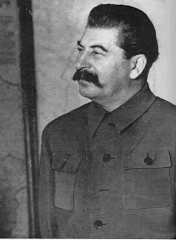
Not to mention that the defeat of fascism was largely accomplished due to the leadership of Joseph Stalin who had to act quickly to feed and educate a starving and mostly illiterate nation, adequately house an impoverished nation while building up its industrial might while the most advanced imperialist countries not only sat back hoping that the new socialist society and government would collapse, but was doing all in their power to try to cripple all efforts by the Soviet people to create a better life than what they inherited by a bunch of arrogant, backwards, mean, selfish and cruel czars who lived off the blood and sweat of the people who wallowed in poverty under a government whose policies were formulated under terms known as “benign neglect.”


Antonio Gramsci, worker, Italian Communist Party organizer, thinker, theorist, philosopher, writer, activist, elected politician and victim of brutal fascist political repression.


Some of the socialists can even wax eloquent about the "Communist Manifesto" but they fail to comprehend--- or possibly in quaintly, caffelatte-liberal fashion ignore the fact--- that the reason Marx and Engels wrote and distributed the "Communist Manifesto" was to help build Communist organizations, i.e. Communist Parties in every country consisting of networks of Communist Party Clubs in working class communities and where people worked and recreated--- something the "red" Finns did quite well in communities in many states across America.


What our middle class socialist friends fail to understand, is that the "Communist Manifesto" packaged with the United Nations' Universal Declaration of Human Rights provides us with a very powerful educational action packet.


And the closest any of these muddle-headed middle class intellectuals can come to bringing themselves to acknowledge the contributions of Communists in building socialism as an alternative to this capitalist system which is rotten to the core, presently on the skids to oblivion, dragging along the working class down the short, bumpy road to perdition is the mention of Lenin’s famous question without acknowledging his name: “What is to be done?”


“What is to be done?,” a question none of these self-proclaimed, muddle-headed middle class intellectual socialists has attempted to even remotely articulate an answer to.


We working class Communists are not afraid to stand our views up against these faux socialists and bring forward real solutions to this current capitalist economic mess now unfolding before us on a global scale which threatens to engulf us all even deeper in wars, poverty, misery and despair all of which has roots in the capitalist system which is based upon the exploitation of labor where there are only two sources of wealth: labor and Mother Nature; capitalists rob the first and rape the latter which is where all of our modern day problems arise.


From reading these essays one would not imagine there are problems involving trying to save jobs by saving factories and entire industries because these “socialists” have never called for the public ownership of a specific factory as a means to saving jobs… nor a comment from any of these “green” socialists as to what should be done to save the jobs of two-thousand workers employed at one of the greenest and largest mass production plants in the world of which a hydro-dam is situated adjacent to it on the Mighty Mississippi River located in the midst of a quaint neighborhood that built up around the plant as workers struggled for their rights to work in a safe and healthy work environment--- a working class struggle which has created one of the greenest communities in North America or, for that matter, anyplace else in the world… and not a single one of these muddle-headed, middle class intellectuals who first posed as progressives supporting Barack Obama now claiming to speak for socialists and socialism who acknowledge they have no political base or political home other than their ivory tower surroundings from which to test their socialist perspectives on us don’t even question that Communists have been left out of this forum on socialism and they completely ignore the very specific problems of working people and the working class as they drone on and on about the need to begin building the movement for socialism behind struggles for reforms.


It boggles my mind that these socialists have the audacity and arrogance to write about working people losing their jobs when they cannot even muster engaging in dialog about saving closing plants as in the auto industry… common sense, never mind socialist understanding which is assumed to contain a modicum of common sense, dictates that you cannot save the jobs of workers whose plants are being literally demolished by capitalists who are so mean and vicious that they will blow up a plant and demolish it just to evade competition from the public sector.


We do not hear from these socialists any suggestions about bringing the St. Paul Ford Twin Cities Assembly Plant and the hydro-dam that has powered the operation for decades compliments of local, state and federal tax-payers who have pretty much subsidized the entire operation including a thirty-million dollar high technology-learning center which is part of the public school system.


One can only “imagine” the kind of movement which might emerge should these socialists The Nation magazine has enlisted to bring us this forum on “reimagining socialism,” should these same writers spend a little time talking to workers at the St. Paul Ford Twin Cities Assembly Plant and other closing plants and mines and mills about their futures’ before sitting down at their keyboards to write these kinds of frivolous essays when working people require so much more.


Are there no workers who are competent writers The Nation could have recruited for its “reimagining socialism” forum?


We do not hear the thoughts of these socialist writers about making the minimum wage a real living wage, constantly updated through appropriate legislation based upon real cost-of-living factors; why not?


We do not hear from any of these muddle-headed, middle class, intellectual, socialists the need to forge a massive united peace movement which begins to really educate the American people to the real nature of imperialism--- the highest and last stage of capitalism in its most decadent form--- by suggesting that instead of 800 U.S. military bases on foreign soil, what we really need is 800 public health care centers spread out across the United States providing free universal access to comprehensive, all-inclusive health care to the American people.


Most of these writers deny that socialism is on the table right now as we are living in what can only be described as the greatest “Marxist moment” in all of human history.


Three wars rage on while many of these “socialists” accept Obama’s concept of “peace” to be the successful imperialist occupation of Iraq where the oil flows to the west as the profits surge into the pockets of the seven thieves comprising the global capitalist oil industry.


Each of these “socialists” talk about how ‘climate change” is one of the greatest dangers we as human beings and our living environment face; but, none of these muddle-headed middle class intellectual socialists will stand with the workers of the St. Paul Ford Twin Cities Assembly Plant struggling to save their jobs and a model of green manufacturing.


All were fully aware of the legislation being put forward by a handful of Minnesota State Legislators to save the plant… none struck a key on their computer keyboards as legislation was defeated by the political allies of Barack Obama in the Minnesota Democratic Farmer-Labor Party--- which derives part of its name from the most advanced political party independent from capital created by progressive, socialists and communists which ruled Minnesota politics for two decades submersed in the day-to-day struggles of working people for a better life… not even a mention from these “socialist” writers in The Nation magazine’s Forum On Socialism about the base and foundation we have from what remains of the Minnesota Farmer-Labor Party… a foundation of progressive and liberal thought that even this Republican Governor and one of the most well oiled and financed Republican machines has not been able to break through and crush.


One has to ask the question of these well-heeled, muddle-headed, middle class, intellectual socialists: What planet are you living on and writing from that you cannot answer even the most basic questions concerning “What Is To Be Done?” when it comes to addressing the specific problems of everyday life working people are experiencing?


Why no mention here from these socialists of the immediate need for a “people’s bailout?” No mention of the “Minnesota People’s Bailout” brought forward by the same small group of progressive Minnesota State Legislators who tried desperately to save the St. Paul Ford Twin Cities Assembly Plant and hydro-dam in trying to save two-thousand good-paying union jobs providing these workers with decent work and a decent life. The “Minnesota People’s Bailout” could easily be used as a template by other state legislatures and the United States Congress to, as Minnesota State Senator David Tomassoni has said: “We need to work our way out of this economic mess not try to buy our way out;” a direct challenge to Barack Obama’s pro-profit, pro-Wall Street, anti-people agenda.


To hear it from these well-heeled, muddle-headed, middle class, intellectual socialists, there are no Wall Street coupon clippers nor capitalist sooth-Sayers… there is only the “high road” to socialism working with friendly capitalists or the “low road” to socialism forced on us by the merchants of death and destruction… according to them, the first road places socialism someplace in the distant future; the latter road may kill us all before we can get there… great excuses for well-heeled, middle class intellectuals to evade the here and now… especially when socialism is so abhorrent to Barack Obama he runs from it like he ran after getting the socialist oriented New Party endorsement in Chicago and ran for the door before saying “thanks;” staying just long enough to, reluctantly, get his picture taken.


It would be nice if just once The Nation magazine and its editor posing as a great defender of “class-less democracy” could see its way to allowing a Communist to venture an opinion on this question of “reimagining socialism” because such an opinion might put a little “zip” and “gusto” into the discussion of these well-heeled, latte-loving, muddle-headed, middle class intellectual socialists whose only value for an expensively bound Communist Manifesto is as an ornament on their ebony coffee tables with ivory drawer handles; intellectuals who fail to bring even the “love me, love me; I’m a liberal” enthusiasm for socialism into this discussion much less bringing forward the needed ideas working people need to become engaged in the struggle for real power… social, political and economic power.


It is almost like these writers are more afraid of socialism than they are of capitalism… they can afford to place socialism on the back-burner for another day waiting for working people to buy their coffee-table books. Working people cannot afford the luxury of such intellectualism as they struggle daily just for survival. Working people cannot afford the luxury of putting off the struggle for socialism because the struggle for socialism is now, more than ever, part of the struggle for survival.


Anyways, read what these writers in The Nation have to say… then read my blog for a working class Communist perspective on what socialist activists are doing as these middle class intellectuals, long divorced from any struggles, are writing about… some of the writings contain some good thoughts we can make use of.


Reading the views of others always helps us strengthen our own ideas about what the politics and economics of livelihood is really all about; real socialism.


To the extent that these essays in The Nation magazine contribute to a wider dialog, discussion and debate about the socialist alternative to capitalism they are most welcome and useful and the writers should be thanked for this; but that is about all… with a couple notable exceptions.


I do find it interesting that The Nation magazine would deny its readers voices from those with a political perspective who organized and led the struggles for the New Deal reforms through building the very powerful “People’s Front” while educating working people and so many people from all walks of life about the socialist alternative to capitalism.


From these writers we read their joke about the socialist economist concerning recession; but, from these socialist writers there is not the acknowledgment we are living in the midst of a full-fledged capitalist economic depression.


I find it rather ironic that these writers in "The Nation Magazine Forum on Reimagining Socialism all seem to think that socialism is not on the table today as if by some kind of pious proclamation they have the right to take it off the table.


Because none of these writers, by virtue of their middle class status, is suffering the brunt of the attacks on the working class creating a crises of everyday living for so many working people they have no sense of urgency to solve any of the myriad of problems working people are just expected to endure. In taking socialism off the table they don't even have the plain old common decency to address the need for specific reforms to alleviate the problems working people are experiencing.


For these middle class intellectuals every demand that working people make for reforms is always too much when they say that things have to be accomplished "incrementally." Socialism is too big of a leap but so is a living minimum wage based upon real cost of living factors is too much at one time.


These muddle-headed middle class intellectual socialists remain quiet as their Democratic Party friends bring forward the idea that a 70 cent increase in the minimum wage should be delayed in this time of crisis for restaurant workers because the bosses would suffer!


To the way of thinking of these muddle-headed middle class intellectuals working people will have to patiently "wait their turn" for Barack Obama's second term.


I am wondering if these middle class intellectual socialists who like to hold up Antonio Gramsci in opposition to Lenin think that Gramsci would set aside this Marxist moment by saying socialism is not on the table?


http://www.thenation.com/doc/20090323/ali


http://www.thenation.com/doc/20090330/davis


http://www.thenation.com/doc/20090330/duggan


http://www.thenation.com/doc/20090323/ehrenreich_fletcher


http://www.thenation.com/doc/20090323/foster


http://www.thenation.com/doc/20090330/henwood


http://www.thenation.com/doc/20090323/mckibben


http://www.thenation.com/doc/20090323/parenti


http://www.thenation.com/doc/20090323/pollin


http://www.thenation.com/doc/20090330/prashad


http://www.thenation.com/doc/20090323/solnit


http://www.thenation.com/doc/20090323/wallerstein


Build a Communist Party Club in your neighborhood, school or workplace today so we can bring real socialist perspectives into the public square for dialog, discussion and debate.


Yours in the struggle,


Alan L. Maki

58891 County Road 13

Warroad, Minnesota 56763

Phone: 218-386-2432

Cell phone: 651-587-5541

E-mail: amaki000@centurytel.net


Check out my blog:


Thoughts From Podunk


http://thepodunkblog.blogspot.com/

Tuesday, March 24, 2009

Rising to the Occasion Reimagining Socialism: A Nation Forum

The Nation.

Socialism's all the rage. "We Are All Socialists Now," Newsweek declares. As the right wing tells it, we're already living in the U.S.S.A. But what do self-identified socialists (and their progressive friends) have to say about capitalism's current troubles? We've asked them, and you can read their spirited replies in the forum that follows this essay. --The Editors

Rising to the Occasion
Reimagining Socialism: A Nation Forum
By Barbara Ehrenreich & Bill Fletcher Jr.

This article appeared in the March 23, 2009 edition of The Nation.

If you haven't heard socialists doing much crowing over the fall of capitalism, it isn't just because there aren't enough of us to make an audible crowing sound. We, as much as anyone on Wall Street in, say, 2006, appreciate the resilience of American capitalism--its ability to regroup and find fresh avenues for growth, as it did after the depressions of 1877, 1893 and the 1930s. In fact, The Communist Manifesto can be read not only as an indictment of capitalism but as a breathless paean to its dynamism. And we all know the joke about the Marxist economist who successfully predicted eleven out of the last three recessions.

But this time the patient may not get up from the table, no matter how many times the electroshock paddles of "stimulus" are applied. We seem to have entered the death spiral where rising unemployment leads to reduced consumption and hence to greater unemployment. Any schadenfreude we might be tempted to feel as executives lose their corporate jets and the erstwhile Masters of the Universe wipe egg from their faces is quickly dashed by the ever more vivid suffering around us. Food pantries and shelters can no longer keep up with the demand; millions face old age without pensions and with their savings gutted; we personally are consumed with anxiety about the future that awaits our children and grandchildren.

Besides, it wasn't supposed to happen this way. There was supposed to be a revolution, remember? The socialist idea, prediction, faith or whatever was that capitalism would fall when people got tired of trying to live on the crumbs that fall from the chins of the rich and rose up in some fashion--preferably inclusively, democratically and nonviolently--and seized the wealth for themselves. Such a seizure would have looked nothing like "nationalization" as currently discussed, in which public wealth flows into the private sector with little or no change in the elites that control it or in the way the control is exercised. Our expectation as socialists was that the huge amount of organizing required for revolutionary change would create an infrastructure for governance, built out of--among other puzzle pieces--unions, community organizations, advocacy groups and new organizations of the unemployed and nouveau poor.

It was also supposed to be a simple matter for the masses to take over or "seize" the physical infrastructure of industrial capitalism--the "means of production"--and start putting it to work for the common good. But much of the means of production has fled overseas--to China, for example, that bastion of authoritarian capitalism. When we look around our increasingly shuttered landscape and survey the ruins of finance capitalism, we see bank upon bank, realty and mortgage companies, title companies, insurance companies, credit-rating agencies and call centers, but not enough enterprises making anything we could actually use, like food or pharmaceuticals. In recent years, capitalism has become increasingly and almost mystically abstract. Outside manufacturing and the service sector, fewer and fewer people could explain to their children what they did for a living. The brightest students went into finance, not physics. The biggest urban buildings housed cubicles and computer screens, not assembly lines, laboratories, studios or classrooms. Even our flagship industry, manufacturing autos, would require major retooling to make something we could use--not more cars, let alone more SUVs, but more windmills, buses and trains.

What is most galling, from a socialist perspective, is the dawning notion that capitalism may be leaving us with less than it found on this planet, about 400 years ago, when the capitalist mode of production began to take off. Marx imagined that industrial capitalism had potentially solved the age-old problem of scarcity and that there was plenty to go around if only it was equitably distributed. But industrial capitalism--with some help from industrial communism--has brought about a level of environmental destruction that threatens our species along with countless others. The climate is warming, the oil supply is peaking, the deserts are advancing and the seas are rising and contain fewer and fewer fish for us to eat. You don't have to be a freaky doomster to see that extinction may be what's next on the agenda.

In this situation, with both long-term biological and day-to-day economic survival in doubt, the only relevant question is: do we have a plan, people? Can we see our way out of this and into a just, democratic, sustainable (add your own favorite adjectives) future?

Let's just put it right out on the table: we don't. At least we don't have some blueprint on how to organize society ready to whip out of our pockets. Lest this sound negligent on our part, we should explain that socialism was an idea about how to rearrange ownership and distribution and, to an extent, governance. It assumed that there was a lot worth owning and distributing; it did not imagine having to come up with an entirely new and environmentally sustainable way of life. Furthermore, the history of socialism has been disfigured by too many cadres who had a perfect plan, if only they could win the next debate, carry out a coup or get enough people to fall into line behind them.

But we do understand--and this is one of the things that make us "socialists"--that the absence of a plan, or at least some sort of deliberative process for figuring out what to do, is no longer an option. The great promise of capitalism, as first suggested by Adam Smith and recently enshrined in "market fundamentalism," was that we didn't have to figure anything out, because the market would take care of everything for us. Instead of promoting self-reliance, this version of free enterprise fostered passivity in the face of that inscrutable deity, the Market. Deregulate, let wages fall to their "natural" level, turn what remains of government into an endless source of bounty for contractors--whee! Well, that hasn't worked, and the core idea of socialism still stands: that people can get together and figure out how to solve their problems, or at least a lot of their problems, collectively. That we--not the market or the capitalists or some elite group of über-planners--have to control our own destiny.

We admit: we don't even have a plan for the deliberative process that we know has to replace the anarchic madness of capitalism. Yes, we have some notion of how it should work, based on our experiences with the civil rights movement, the women's movement and the labor movement, as well as with countless cooperative enterprises. This notion centers on what we still call "participatory democracy," in which all voices are heard and all people equally respected. But we have no precise models of participatory democracy on the scale that is currently called for, involving hundreds of millions, and potentially billions, of participants at a time.

What might this look like? There are some intriguing models to study, like the Brazilian Workers Party's famous experiments in developing a participatory budget in Porto Alegre. Z Magazine founder Michael Albert developed a detailed approach to mass-based planning that he calls participatory economics, or "parecon," and one of us (Fletcher, in his book Solidarity Divided, written with Fernando Gapasin) has proposed a locally based network of people's assemblies. But all this is experimental, and we realize that any system for mass democratic planning will be messy. It will stumble; it will be wrong sometimes; and there will be a lot of running back to the drawing board.

But as socialists we know the spirit in which this great project of collective salvation must be undertaken, and that spirit is solidarity. An antique notion until very recently, it flickered into life again in the symbolism and energy of the Obama campaign. The Yes We Can! chant was the slogan of the United Farm Workers movement and went on to be adopted by various unions and community-based organizations to emphasize what large numbers of people can accomplish through collective action. Even Obama's relatively anodyne calls for a new commitment to volunteerism and community service seem to have inspired a spirit of "giving back." If the idea of democratic planning, of controlling our destiny, is the intellectual content of socialism, then solidarity is its emotional energy source--the moral understanding and the searing conviction that, however overwhelming the challenges, we are in this together.

Solidarity, though, is an empty sentiment without organization--ways of thinking and working together, and of connecting the social movements that are battling injustice every day. We see a tremendous opportunity in the bleak fact that millions of Americans have been rendered redundant by the capitalist economy and are free to dedicate their considerable talents to creating a more just and sustainable alternative. But if we are serious about collective survival in the face of our multiple crises, we have to build organizations, including explicitly socialist ones, that can mobilize this talent, develop leadership and advance local struggles. And we have to be serious, because the capitalist elites who have run things so far have forfeited all trust or even respect, and we--progressives of all stripes--are now the only grown-ups around.

Other Contributions to the Forum

(Note: The links to these essays are in blog above.)

Immanuel Wallerstein, "Follow Brazil's Example"

Bill McKibben, "Together, We Save the Planet"

Rebecca Solnit, "The Revolution Has Already Occurred"

Tariq Ali, "Capitalism's Deadly Logic"

Robert Pollin, "Be Utopian: Demand the Realistic"

John Bellamy Foster, "Economy, Ecology, Empire"

Christian Parenti, "Limits and Horizons"

Doug Henwood, "A Post-Capitalist Future is Possible"

Mike Davis, "The Necessary Eloquence of Protest"

Lisa Duggan, "Imagine Otherwise"

Vijay Prashad, "The Dragons, Their Dragoons"

Kim Moody, "Socialists Need to Be Where the Struggle Is "

Tuesday, February 3, 2009

Wen Jiabao: The crisis has not yet hit the bottom, and it is hard to predict what other problems there will be down the path

"The crisis has not yet hit the bottom, and it is hard to predict what other problems there will be down the path,” Wen Jiabao

I suppose one should consider Wen Jiabao carrying around a copy of Adam Smith's book, "Theory of Moral Sentiments," an improvement over carrying around Mao's "Little Red Book;" however, Adam Smith certainly does not explain capitalist economic depressions nor what comes after capitalism.

I do find it an interesting technique Wen Jiabao is using to throw talk about "moral sentiments" in the face of capitalists... however, we really need to be asking why he isn't also following up with an even stronger dose of Marxism.

Morality has never been a very powerful influence on capitalists in spite of all their studies of Adam Smith... we have seen capitalist "morality" in play in Gaza in recent days. We witnessed capitalist "morality" in what came with Hurricane Katrina.

One must suspect that Barack Obama in his studies at Harvard was likely to have very thoroughly studied Adan Smith's, "Theory of Moral Sentiments;" yet, Obama remained silent as the Israeli killing machine slaughtered hundreds in a shocking, modern day pogrom.

Wen Jiaboa is preaching to the capitalist hypocrites like those who used to wave Mao's "Little Red Book" of quotations in the fight against imperialism. All Wen Jiaboa has to do is add a few quotes from the Bible to make his dog-and-pony show complete and he will have an act fit to star in the center ring under the Big Top in the capitalist circus. Perhaps some clown will even toss a shoe at Wen Jiaboa's head to bring the act to conclusion before a gaggle of clowns comes in to allow him to leave the center ring to get us ready for the main act--- Barack Obama.

This is a very interesting comment coming from Wen Jiabao, the Chinese leader who is supposed to be a Communist.

This comment causes one to wonder if Wen Jiabao has ever studied Marxism because he demonstrates very little grasp of the capitalist economy in making this statement... and he demonstrates an even shallower understanding of Marxism in saying, in this interview, that he "thought things were beginning to turn around."

Wen Jiabao only would have to read basic Marxist texts like "Socialism: Utopian and Scientific" to understand the capitalist economy is coming crashing down in a depression which should enable Wen Jiabao to conclude that China will have to find solutions to its problems in expanding socialist democracy and the socialist economy rather then by collaborating with the imperialists.

Very troubling is Wen Jiabao's remark: "I want to make clear here that I will be most sincere in all my answers, but I may not tell you everything.

"May not tell you everything," is a very disconcerting comment coming from one who lays claim to being a Communist leader.

Why would any Communist refuse to tell working people in China or any place else in the world what he or she fully understands and knows?

Communists have never withheld the truth from working people... only the faux--- fake Communists, the revisionists and sellouts--- who find protection in cuddling up to capitalist politicians like Barack Obama and the Wall Street crowd pulling Obama's strings, rather than throwing in their lot with the working class proceed in such a dishonest manner.

In fact, it is relatively easy for any working class woman or man to figure out what is going on and just how desperate the situation is; a situation which a leader of the U.S. Federal Reserve Board has described as, "Not your garden variety recession."

In fact, to begin to understand what is going on with the capitalist economy we have to understand that this is not merely a "global economic downturn;" but, rather, a global capitalist economic depression of immense proportions from which capitalism is never going to "recover."

All the facts are there for Wen Jiabao, or anyone else to see, if they are open-minded enough to try to understand what is happening.

It will be virtually impossible for anyone to understand what is going on with the capitalist economy without turning to Marxism for answers simply because Karl Marx and Frederick Engels made the most exhaustive study of the capitalist economy.

One does not have to be a Communist to read and study what the Marxists have to say about economics; however, solving the problems capitalism has created is another matter.

The capitalists have reaped the profits and left the working class with poverty and problems... huge problems; the closer we examine the problems the reality is the larger the problems become.

Make no mistake, capitalism is on the skids to oblivion and humanity is now well along down the road to perdition.

Frederick Engels, Karl Marx' friend, colleague and comrade had this to say which very clearly defines what is happening to the capitalist economy today:

From: Frederick Engels's--- Socialism: Utopian and Scientific/ (part of his /Anti-Dühring/), is a description of the crisis of capitalism that seems uncannily appropriate to today.


* * *

Commerce is at a standstill, the markets are glutted, products accumulate, as multitudinous as they are unsaleable, hard cash disappears, credit vanishes, factories are closed, the mass of the workers are in want of the means of subsistence, because they have produced too much of the means of subsistence; bankruptcy follows upon bankruptcy, execution upon execution. The stagnation lasts for years; productive forces and products are wasted and destroyed wholesale, until the accumulated mass of commodities finally filter off, more or less depreciated in value, until production and exchange gradually begin to move again. Little by little the pace quickens. It becomes a trot. The industrial trot breaks into a canter, the canter in turn grows into the headlong gallop of a perfect steeplechase of industry, commercial credit and speculation, which finally, after breakneck leaps, ends where it began--in the ditch of a crisis. And so over and over again. We have now, since the year 1825, gone through this five times, and at the present moment (1877) we are going through it for the sixth time.... The fact that the socialised organisation of production within the factory has developed so far that it has become incompatible with the anarchy of production in society, which exists side by side with and dominates it, is brought home to the capitalists themselves by the violent concentration of capital that occurs during crises, through the ruin of many large, and a still greater number of small, capitalists. The whole mechanism of the capitalist mode of production breaks down under the pressure of the productive forces, its own creations. It is no longer able to turn all this mass of means of production into capital. They lie fallow, and for that very reason the industrial reserve army must also lie fallow. Means of production, means of subsistence, available labourers, all the elements of production and of general wealth, are present in abundance. But "abundance becomes the source of distress and want" (Fourier), because it is the very thing that prevents the transformation of the means of production and subsistence into capital. For in capitalistic society the means of production can only function when they have undergone a preliminary transformation into capital, into the means of exploiting human labour power.

Frederick Engels's---
Socialism: Utopian and Scientific/
part of his...
Anti Dühring/
New York: International Publishers, 1935, pages 64-65


Perhaps Wen Jiabao doesn't feel comfortable citing Frederick Engels for fear of offending his new found capitalist friends... however, if anyone believes this is not what is happening with the capitalist economy they should step forward with their reasons... Wen Jiabao failing to point this out is not helping anyone except a small grouping of capitalist who continue to cling to power simply because so many working people do not understand what Engels was writing about.

The problems are too big and far to complex for capitalism to resolve.

Hurricane Katrina exposed this; even though there are many who would like to dump all blame on George Bush.For sure George Bush was a big part of the problem; but, what hurricane Katrina and the aftermath demonstrated is that capitalism is simply not able to solve big problems in a way that is good for most of the people--- people who happen to be, in the majority, working people who are suffering. Katrina created the damage, but, Mother Nature was assisted in her rage by a very corrupt government which had abandoned taking care of public infrastructure as capitalists stole the wealth created by workers, thus preventing proper maintenance of dikes and canals, etc. And after the damage was done, there have been no resources to repair the damage and restore the community because capitalists are hoarding the wealth--- funds which should be available to rebuild after such a natural disaster.

Whether in the aftermath of Katrina or the many other problems now being experienced by people across the globe we are all confronted with a common problem: The tremendous wealth working people have created now belongs to the capitalist exploiters and we are confronted with the very problem Frederick Engels describes above which Wen Jiabao either is not familiar with like so many other people, or, this is one of those things he chooses not to talk about.

This is a very important interview; what is sad is that working people have to read between the lines and try to figure out what Wen Jiabao did not tell... fortunately, we can study Marxism for ourselves to learn what Wen Jiabao has apparently promised his new found capitalist friends he would not tell working people.

This is a very interesting article from the Financial Times and a very informative interview. I would encourage everyone to read, and re-read the article and interview.

I would suggest that in reading the article and interview that you repeatedly ask yourself: What is going to happen to the lives of working people on the way down to "the bottom;" and, do we really want to find out what is waiting for us "at the bottom?"

I do not use the word "perdition" loosely.

Make no mistake, capitalism is on the skids to oblivion and we are well down the capitalist road to perdition.

Wen Jiabao in stating, "it is hard to predict what other problems there will be down the path" would have been more accurate--- and honest--- in stating something like: try to imagine the problems before us on the capitalist path; whatever problems you might imagine, the problems are going to be much worse.

Alan L. Maki


[Note: The Full Transcript of the interview with Wen Jiabao from the Financial Times of London upon which the story below is based can be found at the end of this story.]

Downturn causes 20 million job losses in China

By Jamil Anderlini in Beijing and Geoff Dyer in London

http://www.ft.com/cms/s/0/19c25aea-f0f5-11dd-8790-0000779fd2ac.html?nclick_check=1

Published: February 2 2009

More than 20 million rural migrant workers in China have lost their jobs and returned to their home villages or towns as a result of the global economic crisis, government figures revealed on Monday.

By the start of the Chinese new year festival on January 25, 15.3 per cent of China’s 130m migrant workers had lost their jobs and left coastal manufacturing centres to return home, said officials quoting a survey from the agriculture ministry.


The job losses were a direct result of the global economic crisis and its impact on export-oriented manufacturers, said Chen Xiwen, director of the Office of Central Rural Work Leading Group. He warned that the flood of unemployed migrants would pose challenges to social stability in the countryside.

The figure of 20 million unemployed migrants does not include those who have stayed in cities to look for work after being made redundant and is substantially higher than the figure of 12 million that Wen Jiabao, premier, gave to the Financial Times in an interview on Sunday. Speaking on a visit to the UK on Monday, Mr Wen said there had been signs at the end of last year the Chinese economy might be starting to recover.

In a speech at Cambridge University later, he warned that the global economy could face further problems. “The crisis has not yet hit the bottom, and it is hard to predict what other problems there will be down the path,” he said. Governments should avoid any policies that allowed them to “progress at the expense of others”, he added.

Mr Wen’s speech was interrupted by a protester who called him a “dictator” and threw a shoe at the stage – an act reminiscent of the Iraqi journalist who threw shoes at George W. Bush, former US president, at a press conference in Baghdad last year. Police said they had arrested the man.

Production in China’s manufacturing sector declined for the sixth successive month in January, according to Hong Kong brokerage CLSA, which said on Monday that its purchasing managers’ index hit 42.2, up marginally from December but well below the no-change mark of 50.


This is the Full Transcript of the interview the story above with Wen Jiabao is based on.

Published: February 2 2009 10:51 | Last updated: February 2 2009 10:51

The interview was conducted by Lionel Barber, editor of the Financial Times

Wen Jiabao: I want to make clear here that I will be most sincere in all my answers, but I may not tell you everything.

Lionel Barber: Premier, when you were in Davos this week, and everybody was talking about how to restore confidence, there was also some talk about shooting bankers; that certainly will not restore confidence. What can China do today, in this global financial crisis, to restore confidence?

WJ: Yes, indeed, I attended the Davos WEF Annual Meeting, and paid a visit to the European countries. I want to call this trip a journey of confidence. I have brought with me confidence in tiding over the difficulties caused by the financial crisis. I have brought with me the confidence that China will work closely with the European countries to push forward our strategic partnership. And I have brought with me the confidence that China will work with the international community to get through the difficult times together.

I’m confident that the Chinese economy will be able to get through the difficult times caused by the financial crisis. This confidence has been based on a scientific approach, as well as the realities in today’s world, as well as in China. The source of my confidence is based on the correct judgment we have made of the current situation.

I feel confident, because over the past 30 years of reform and opening up, China has put in place a solid, material and technical foundation, and we have now in place good institutions and mechanisms.

I’m confident because China has a stable financial system. And also because China has a big market potential and a large room for manoeuvre.

Most importantly, my confidence is based on the decisive and firm decisions that the Chinese government has adopted. We took these decisions with great intensity and at a proper pace.

I think I have given you a sketch of what the Chinese government has done, and if you are interested in any details, I’m ready to answer any question.

LB: Is this stimulus package big enough? Or do you believe further measures will be needed?

WJ: In meeting the financial crisis, it is imperative that governments must adopt a big enough package plan to stimulate the economic development. Such a plan must be comprehensive and complete. It must target both the root causes and symptoms of the issues, and also take into account both immediate difficulties and long term development.

Our package plan has five key components.

Number one: we want to stimulate greater domestic demand that will be mainly supported by massive government spending.

Number two: we are making adjustment to, and revitalising ten key industries.

Number three: we will take steps to advance technical upgrading.

Number four: we aim to put in place a fairly comprehensive safety net.

And number five: we aim to preserve financial stability to support economic development.

Do you want me to cite some figures, or statistics of that?

We have an investment programme worth Rmb4 trillion within two years to stimulate domestic demand, especially consumer demand.

We will spend Rmb600bn on scientific and technical innovation and technical upgrading.

We will make an investment of Rmb850bn for the improvement of medical and health care system.

The financial crisis has not yet hit the bottom, and we will continue to follow very closely the development of the situation.

We may take further new timely and decisive measures…

All these measures have to be taken pre-emptively before an economic recession, so as to maximise the desirable effect, otherwise our efforts will be wasted.

LB: Did you see, as many economists in Asia witnessed, a very sharp decline in GDP in the fourth quarter in China, like falling off a cliff?

WJ: China’s GDP was at 9 per cent as a whole last year, but in the fourth quarter of 2008 we also had a big decline and it fell to 6.8 per cent. As a result of the international financial crisis, we are seeing the diminishing external demand.

Our businesses are now experiencing difficulties. We now have over capacity in some industries and also rising unemployment. Our economy is under increased downward pressure and all this means that we are now facing great difficulties. Maybe you will ask how come you still feel confident under such circumstances.

LB: How can you be so confident that you can magically hit that 8 per cent figure? And how can you stop all those statistical experts saying.

WJ: Well, I think this is dependent on four factors. First, we must ensure that all policy measures we have adopted are the right ones as well as the effective ones. So far all these policy measures we have adopted are aimed at stimulating the real economy and also stimulating spending.

Well, actually the major impact of the financial crisis on the Chinese economy has been on its real economy. Secondly, one must act fast. We started to take action from July last year and we started to adopt massive steps from October last year.

During last December the central government took the decision of making an investment of Rmb100bn and I can tell you now that this investment has been put in place in terms of real funds and on what projects the money will be spent. Before the Spring Festival we also made available another investment of Rmb130bn and the funds were disbursed to the necessary projects.

Thirdly, we must take forceful steps. Under special circumstances; necessary and extraordinary measures are required. We should not be restricted by conventions.

Success or failure depends on the pace and intensity of those measures. Fourth, we must make sure that these measures are effective ones.

Around the end of last year and early this year we took steps to make the household appliances, agricultural machinery, as well as automobiles more available to the rural areas of China.

From the beginning of January this year we started to undertake the transformation of the value added tax in China, which saved businesses in China Rmb120bn. All these measures have already been implemented.

LB: Consumer spending, Premier Wen, is crucial. Do you agree with the proposition that consumer spending is patriotic?

WJ: We would not put it as simply as that. I think that is a view that is maybe held by some media people or by some individuals.

But we do believe that consumer spending is vital in boosting economic development. I don’t think we can know how much a consumer will spend eventually, and whether he wants to spend is not dependant on what kind of slogan we have.

But it is really dependant on how much money he has in his pocket and whether we have those marketable products available. We have actually taken some steps to address this issue. At the beginning of this year we gave lump sum subsidies to 74 million people.

On average each will have Rmb100 to Rmb150. For the fifth time we have raised the pension benefits for enterprise retirees by 10 per cent and each one will have Rmb110. We have also increased the basic cost of living for people living in difficult circumstances and increased the special assistance and allowances for the groups who are entitled to them. We have also taken another step that is very difficult.

That is we have increased the wages for the 12m middle and primary school teachers who are in the compulsory education period in the Chinese educational system. We want to bring the wage level of those teachers up to the same level as the public servants.

I think people will be ready to spend when they have the money. We also took the policy that from January 20 2009 to December 31st 2009 there will be a policy of halving the purchasing tax of vehicles of 1.6 litre engines or below, and on the first day the policy was introduced it gave such a strong boost to the sales of automobiles on the Chinese market that even the inventories were all gone.

LB: Before I turn to the international aspects of this crisis I have one small question regarding rural China. You visited over 2,000 Chinese counties I understand? What specific measures are you taking to assure social stability as unemployment rises and many, many people are returning to the land? And within that question, one last question on the Agricultural Bank of China. Are you planning to use $800bn to recapitalise it.

Translator: The Agricultural Bank of China?

WJ: When I was Vice Premier of the State Council rural affairs in China were already a part of my portfolio, and since I became the Premier of the State Council I have always put rural affairs at the forefront of the government agenda in relation to the development of the Chinese economy.

As you said, the financial crisis has caused some bankruptcies of businesses and also made the migrant workers return to the countryside. In total we have about 12m migrant workers who have returned to the rural areas.

Some western countries may wonder whether this will be a source of social instability. Well, I want to tell you that in China we have altogether about 200m migrant workers working in the urban areas, and the population of migrant workers searching jobs across provinces is about 120m.

As I said, about 12m migrant workers have chosen to return to the countryside because of the financial crisis. As this is a floating population, it is easy to understand that they will come to cities when there are job opportunities there and they will choose to return to the countryside when there aren’t.

When they have returned to the countryside you can see that, for most of them, they still have their piece of land in the rural areas. I think land provides the most important safeguard for the lives of those farmers in China.

We should thank those Chinese migrant workers because they made an enormous contribution to China’s modernisation drive and, in times of this financial crisis, they have also become a big reservoir of the labour force.

With regard to the Agricultural Bank of China, this is the last bank among the five major commercial banks in China which is undertaking reform.

I want to point out one thing here, that it is largely because we started the reform in China’s banking sector about 10 years ago that now we have seen the Chinese major banks are now in a fairly healthy condition in terms of the quality and scale of their assets, the profitability of those banks, the proportion of NPLs (non-performing loans), as well as the flow of capital in those banks. We took these measures, including the reducing of non-performing loans in the banks, improving the corporate governance structure in the banks, as well as making them shareholding companies.

There are four key priorities in our reform with regard to the ABC. One is that we must ensure this reform will serve the purpose of agricultural development. Secondly, we must take continued measures to dispose of those non-performing assets. Number three, the government will take steps to inject capital into the bank. Fourthly, we will undertake the reform of putting in place a corporate governance structure. Our decision on this recapitalisation is about US$30bn

LB: You’ve outlined some important measures that China has taken to stimulate its economy but the world expects so much of China, and America in particular. This past year there was more pressure on China regarding the renminbi and the Treasury secretary referred to China “manipulating” its currency. Have you received assurances from President Obama that America will be more accommodating, and what do you say to those charges that you are manipulating your own money?

WJ: To allege that China is manipulating its currency exchange rate is completely unfounded. From the second half of 2005 we have started to conduct the reform in China’s exchange rate regime. With more than three years of the reform, the renminbi has appreciated by 21 per cent in actual terms against the US dollar and 12 per cent against the Euro.

Now we have in place a market based managed floating exchange rate regime with a reference to a basket of currencies. This regime is consistent with China’s actual conditions and meets China’s actual needs. I want to make very clear here that it’s to maintain the basic stability of the Chinese renminbi on a reasonable and balanced level.

It’s not only in the interests of China but also the world economy. It is in the interests of the efforts of the international community in overcoming the financial crisis. Many people have not come to see this point. If we have drastic fluctuations in the renminbi exchange rate it will only be a big disaster

LB: If I understand you, Premier Wen, you are supporting what the Chinese authorities said 10 years ago with the ruling out of a depreciation of renminbi?

WJ: I think I have made my point very clear. That is, we practise a managed floating exchange rate regime and we preserve the basic stability of the exchange rate on a reasonable and balanced level.

LB: Everybody understands that the current financial crisis was manufactured, if you like, in America. It originated in America. There were many mistakes made in terms of managing risk and regulation but what do you say to those who believe that a part of the problem is the imbalance in the world economy, with China’s $2 trillion of reserves?

WJ: I think such a view is ridiculous. I think the reason for this financial crisis is the imbalance of some economies themselves. They have for a long time had double deficits and they keep up a high level of consumption on the basis of mass borrowing.

In those economies the financial institutions have not been put under effective regulation and the financial institutions have reaped massive profits with a very high leverage ratio.

Once such a bubble bursts, the whole world has been exposed to a big disaster. China is a very big developing country, with 1.3bn population.

The per capita GDP of China is only 1/16th of that of the UK. We do need a large pool of financial resources to achieve economic development and improve the people’s livelihood.

I think that it is confusing right and wrong when people who have been overspending blame those who lent them the money. In Chinese there is actually a proverb expressing this kind of situation which proves the character in the Chinese novel, Journey to the West, Zhu Ba Jie.

The proverb means to blame those who have actually done you a favour for your own wrongdoing. Well, when I shared this view of mine with the business leaders at Davos, they agreed with me on this.

LB: Premier, you're still going to buy US Treasury bonds, I hope.

WJ: Well, this is indeed a very sensitive issue. We do have very big foreign exchange reserves, and these reserves must be well run. Buying foreign Treasury bonds is one way of running these massive reserves. But as to whether we will continue to buy the Treasury bonds, and how many we are going to buy, I think we need to take into consideration China's own needs, and also the need that we must maintain the safety and the good value of our foreign exchange reserves.

We want to see the turnaround, or the recovery of the US economy. We believe that to maintain a stable international financial market is in the interests of shoring up market confidence, overcoming the financial crisis, and facilitating early recovery of the international markets.

LB: Would China be prepared to support the calls in some quarters for some of the reserves to be recycled through the IMF in return for the necessary award of greater votes for China in the IMF to help to manage this global financial crisis?

WJ: We believe it is imperative that we should first undertake reform in international financial institutions, including the IMF. And through the reform, we should increase the voting share, the representation, and the say of developing countries. At the same time, the oversight of how the capital at international financial institutions is used should be strengthened.

LB: I asked the question because for 30 years some people have said capitalism will save China, and now maybe people are saying China must save capitalism.

WJ: Well, I don’t see it this way. I still have a very clear mind on this particular point. China remains a big developing country with a 1.3bn population. We do face arduous tasks, and our way ahead will be a long one.

If you have seen the Chinese cities in the coastal areas, maybe you don't see much a difference between those cities and London, but if you have ever been to China's rural areas, particularly the western areas of China, you will see a big gap.

I firmly believe that running our own affairs well is the biggest contribution to entire mankind. I think there are three must-dos. First, we must address both the symptoms and root causes of the problem. One should not only tend to the head when the head aches, or tend to the foot when the foot hurts. We must enhance cooperation rather than enter into a confrontational relationship. We must run our own affairs well respectively, instead of shifting troubles to others.

LB: Premier Wen, did President Obama offer some assurances in this respect?

WJ: It has not been long since the inaugural speech of President Obama. We have been following closely the statements made by the new US administration. We look forward to early contacts with the new US government, and we believe that to maintain cooperation between China and the United States serves world peace, stability and prosperity.

LB: With respect, Premier Wen, just to press you, so it's not correct - some reports have said that President Obama has given a personal message reassuring China that the renminbi and other matters will not be used in an aggressive way; that America will be more accommodating? There's no personal message?

WJ: In his telephone conversation with President Hu Jintao the day before yesterday, he expressed his readiness to enhance cooperation with China. Yet, at the same time, we do see there are different voices within the United States itself. I hope the FT can convey a message from me to the US side. We want to enhance cooperation with the United States to meet the financial crisis together as that represents the larger interest, and it serves the fundamental interests of both countries.

LB: Yes, the problem may be even more in Congress than in the administration. So do you have a message for Congress?

WJ: We don't comment on the system of the United States. I think the US government has a decisive role to play in making the right decisions. The US government should view its relations with China from a long-term and strategic perspective, and under the current circumstances, the priority of the two countries should be working together to fight the financial crisis and promote the constructive and cooperative relations between China and the United States.

LB: Just to return to the reserves very quickly. Did I understand that the Chinese government may use some of the reserves for spending programmes at home to stimulate the economy?

WJ: Foreign exchanges reserves reflect the economic strength of a country. We are now studying how we can make the best use of the foreign exchange reserves in China. On this particular topic, you are all experts. And for banks, I think foreign exchange reserves are liabilities of the central bank, and if a government wants to make use of the foreign exchange reserves, it has to issue government bonds to buy the foreign exchange reserves.

We are now having discussions about how to make rational and effective use of the Chinese foreign exchange reserves to serve the purpose of economic development in China. Last year, we issued Rmb1.5 trillion of government bonds in purchasing US$200bn of foreign exchange reserves to inject capital into the China Investment Corporation.

Foreign exchange must be spent overseas, and it will be spent mainly on foreign trade and investment. Therefore, we want to use foreign exchange to buy the much-needed technology equipment and products. That is a quite technical issue.

LB: The world expects so much from China. China is taking very important steps to increase research and technology on renewable energy. But later this year, there will be a summit in Copenhagen on climate change. Is China ready to sign a treaty to cap carbon emissions?

WJ: I had a thorough discussion about this issue with President Barroso of the European Commission in Brussels the day before yesterday. The Chinese position on this issue is as follows.

Number one, China supports the Copenhagen conference. It supports all measures which are playing their roles in meeting the challenge of climate change, and we support the development of a green economy. We are of the view that to develop a green economy is probably another area in the economy as we meet the international financial crisis.

Number two, the Chinese government gives top priority to meeting the challenge of climate change. We have established a national leadership group on tackling climate change, and I'm head of the group.

We have formulated a national programme on coping with climate change, and this is not only the first programme of its kind for China, but also the first one of its kind among all developing countries.

In China's 11th five-year plan, we have set ourselves obligatory targets in saving energy and reducing pollution. The target requires us that we must reduce the per unit GDP energy consumption by 4 per cent every year, and in total by 20 per cent in five years.

We failed to meet the targets in the first two years of the five-year period, and we succeeded in meeting the target in 2008. We will continue to make efforts on this front and set targets for ourselves. I think this can be seen as a way that China is holding itself accountable to the relevant targets.

Number three, it's difficult for China to take quantified emission reduction quotas at the Copenhagen conference, because this country is still at an early stage of development. Europe started its industrialisation several hundred years ago, but for China, it has only been dozens of years.

China has a 1.3bn population, and in terms of per capita greenhouse gas emission, we are certainly not the biggest one, yet we are still very active and positive about our cooperation with Europe in terms of saving energy, reducing pollution, developing a low carbon economy, and developing those environmentally friendly technologies.

LB: Premier Wen, I've been told if I ask a political question, I have to be very careful.

WJ: Ask any question you want.

LB: I have to be careful, because [according to the saying in] Mandarin, I will get hat, shoes and gloves. But looking to the future, could you imagine there being direct elections to the National People's Congress, say, in ten years?

WJ: Well, actually, I think economic life and political life are not separable from each other. Let me address this political question from you from an economic perspective. We are undertaking both economic restructuring and political restructuring, and both are very important.

Without the successful political restructuring, one can't ensure success in our economic restructuring. The goal in our political restructuring endeavour is to promote socialist democracy, and better ensure people's rights to democratic election, democratic decision making, democratic management, and democratic supervision.

The society that we desire is one of equity and justice, is one in which people can achieve all round development in a free and equal environment. That is also why I like Adam Smith's Theory of Moral Sentiments very much.

In 1776, Adam Smith wrote the Wealth of the Nations. And in the same historical period, he wrote the Theory of Moral Sentiments. Adam Smith made excellent arguments in his Theory of Moral Sentiments. He said in the book to the effect that if fruits of a society’s economic development can not be shared by all, it is morally unsound and risky, as it is bound to jeopardize social stability .If the wealth of a society is concentrated in the hands of a small number of people, then this is against the popular will, and the society is bound to be unstable.

Like truth is the primary virtue in thinking, I have always believed that justice and equity are the primary virtue in the socialist system. In the eyes of the West it seems that the Chinese are afraid of democracy or elections. Actually, this is not true.

As I told the press during the press conference of the NPC session early last year, I said that only when people trust you, will they support you in your office. Now we have direct elections at village level and also direct elections of People’s Deputies at township level. At the same time, I have always believed that if the people have the ability to run the village affairs well they are capable of running the township affairs and the county affairs and then running the provincial affairs. In this entire process we should take a step by step approach in the light of China’s own conditions and to develop a democracy with Chinese features.

LB: So there’s a bit more room for democracy and a bit more room for dissent as part of a democracy?

WJ: Well, I don’t think a government should feel afraid of its own people. I think it should create opportunities for the people to better hold the government accountable.

LB: Premier Wen, I realise we’re running short of time. I had my own quote from the Theory of Moral Sentiments.

WJ: Well, I think for quite some time this book has not attracted due attention or attention that it deserves. I think it is as important as The Wealth of Nations. He made a reference to the invisible hand only on two occasions in these books. One, he refers to the market; the other, he talks about the morality. And please go ahead with your quote.

LB: “How selfish soever man may be supposed, there are evidently some principles in his nature, which interest him in the fortunes of others and render their happiness necessary to it, though he derives nothing from it except the pleasure of seeing it.”

WJ: I think this is very well said, and I have been reading the book and this book I carried with me in my suitcase on the trip.

LB: Thank you very much for agreeing to talk to the Financial Times. It’s been very enlightening.

WJ: Thank you.

Monday, January 12, 2009

North Winnipeg’s Seal of Identity

http://canadiandimension.com/articles/2009/01/07/2292/

North Winnipeg’s Seal of Identity

Leo Panitch

Canadian Dimension magazine, January/February 2009

A Glowing Dream: A Memoir

by Roland Penner

J. Gordon Shillingford Publishing, 2007

“The place of childhood provides the seal of identity.” This epigram opens the first chapter of Roland Penner’s memoir, “Growing Up ‘Red’ in Winnipeg’s North End.” It holds true even for those of us who grew up only “pink” — i.e. whose parents were CCFers rather than Communists, and who as a result never set foot in the Ukrainian Labour Temple at Pritchard and McGregor. Just how much Winnipeg’s working-class political culture sealed our identities was brought home to me last year when I sent my brother an article that touched on the strike at the Hurtig Fur Company in the early 1930s — during the course of which my father, while on the picket line, had his head split open by a scab. My brother, who was born in 1934, responded: “You know, when I was a little boy I used to get confused about whether the really bad guy’s name was Hurtig or Hitler.”

To be sure, the industrial side of Winnipeg’s history of class conflict makes very little appearance in this memoir — apart from a few sentences that recall Roland standing as a teenager “on the bald prairie with the temperature at about wind chill -50°F, handing out union leaflets” as part of an organizing drive at a plant on the outskirts of Transcona. This is hardly surprising, since the Penner family was preeminent for its involvement on the political side of the labour movement — so much so that on one memorable May Day, after some five thousand paraded along Portage Avenue and Main Street to end up at Market Square in front of the old City Hall, the three speakers who addressed them were Penner’s politically passionate and fiery mother, Rose; his eleven-year-old “child orator” brother, Norman; and, of course, his venerable father, Jacob, the famous Communist alderman for Ward Three. (Jacob Penner was “almost always dressed in a conservatively cut three-piece wool suit, a shirt with a stiff celluloid collar, a firmly knotted woolen tie, a carefully blocked and immaculately clean fedora, and sometimes, over his shoes, spats.”)

The story told here of the Penner family is a fascinating one, from its origins among downwardly mobile Mennonite ancestors who once owned an estate on the west bank of the Dniepr River to Jacob’s “form of marriage without clergy” to a Jewish orphan from Odessa, Rose Shapak. One of the most revealing aspects of north Winnipeg’s ethnic culture is uncovered here, as Jacob the Red, before his election as alderman in 1934 at the age of 54, moves from job to job for some two decades, including as a candy salesman with the help of Rose’s connection to the well-off Galpern family. Just as class conflict tore the Jewish community apart in a strike like the one at Hurtig’s, so did family ties often transcend the sharpest of differences in the class politics of Winnipeg’s North End.

The family anecdotes in this book are so profuse that many of the best are found in the footnotes. One of Rose’s nephews goes to the U.S.S.R. in 1933 and gets swept away five years later in Stalin’s murder machine. One of Jake’s brothers-in-law returns home after a visit to Germany in 1936, and becomes a supporter of the Winnipeg Nazi Party. Shortly after Jake is sent off to an internment camp as a Communist in 1940, sixteen-year-old Roland and his twin sister Ruthie are home alone listening to “Saturday Afternoon at the Met” (while Rose is in Ottawa heading up a delegation of wives petitioning for improvements in the camp’s conditions), and the RCMP come barging in waving a search warrant. As one Mountie moves to turn off the radio, Ruthie screams at him: “In this house no one turns off the opera!”

Indeed, so plentiful are Penner’s family anecdotes that one terrific example, which he told when Norman was honoured at a banquet at the University of Manitoba some two decades ago, is left out of this book. As I recall it (and have often retold it), when Norman marched into the principal’s office of his grade school to complain that the phys-ed instructor was picking on him because he was a Communist, the principal sternly and accusingly said (so everyone in the outer office could hear): “You’re a Communist?!” And then, after closing the door, he whispered, “So am I.”

Penner’s admiration for his parents’ Communist politics is palpable, and he explicitly contrasts this with the way other “red diaper babies” like Jim Laxer and Stan Gray have written disparagingly of their parents’ politics. Quoting Laxer to the effect that truth was “a very slippery commodity” in his home, Roland proudly writes: “That was not our experience…. We asked many questions and Dad and our mother told us what they sincerely believed to be true.” His father remains his “primary inspiration” — a man who “fought for the rights of others at great cost to himself” — and this is why his parents commitment to the “Glowing Dream” forms the title of his memoir. Yet, one might have wished that Roland had offered a more sober reflection on his father’s generation of Canadian Communists, not only with regard to what they knew or didn’t know about Stalin’s crimes in the U.S.S.R. or to the limitations of “democratic centralist” life inside the party, but also to the reformist strategy it pursued in the public arena.

Thus, we learn that Jacob Penner left the Socialist Party of Canada in 1911 because he felt it was too oriented toward raising class consciousness through Marxist education alone. He devoted himself to a life of “unceasing struggle for [the] daily needs and pressing problems” of working people in the belief that this practical activity would raise their consciousness as “the essential feature in the development of a socialist revolution.” Yet, when he died in 1965, aged 85 (having only retired as alderman three years earlier), the Winnipeg Free Press made a point of saying that he was a “political curiosity” who drew much of his support from people “who cared nothing for politics but who admired his efficiency and ability and who believed that he worked for the underdog.” Penner quotes this approvingly, without raising the question of how far this achievement nevertheless stood from the development of the class consciousness needed for supporting socialist revolution, which had been Jake’s original purpose. Would more attention to creative Marxist education have produced a better result? This memoir doesn’t go there, perhaps because Roland, from the time of his own engagement in student politics at the University of Manitoba in the late 1940s, adopted a stance “quite in keeping with my father’s approach to political activity on an issue-by-issue basis.” This approach did not mean that he often lost his bearings on the Left of the political spectrum — far from it. But as the main part of the memoir turns to cover Roland’s own adult political life, this “issue-by-issue” approach is visible all along the way: from his slow drift away from the CP (rather than exiting in flames as his brother did in 1957); to his joining Joe Zuken’s law firm; to his foundational role in the establishment of legal aid in Manitoba; to his almost happenstance decision to join the NDP; to what he calls his “life in government” as attorney general of Manitoba.

The limits of this approach came to a head with his role in the Meech Lake Accord, which he still sees as “a reasonable compromise” on the grounds that, while he agrees with those critics who said that “the separatists would always ask for more,” if the Accord had passed it would have ensured that “their call to break up the country [would have] fallen on less fertile ground.” This is pretty conventional stuff. He reserves his real ire, moreover, for the left critics of the Accord, especially those “many women … influenced by flamboyant statements … by Judy Rebick and the National Action Committee,” who saw the deal as concocted by “men in suits” with the aim of using Quebec’s recognition as a distinct society to override the Charter’s equality provisions (“This is, in my view, nonsense.”) and undermine federal social programs (the likelihood of which he sees as “essentially nil”).

Penner’s decision to side with the pragmatic men in suits against the socialist feminists during the Meech Lake controversy in 1987 was presaged by the controversy over the stand he took in 1983 over the newly opened Morgentaler abortion clinic in Winnipeg. In justifying why as attorney general he could not “authorize a blanket stay of proceedings” with respect to criminal charges against Morgentaler, Penner clearly sees himself as properly following the advice Justice Samuel Freedman gave him when he invited Penner to lunch after his appointment: the Attorney General “must not be political.” But if Penner now admits that his Morgentaler moment “still comes back to haunt me from time to time,” this may be because he knows very well (as he puts it in the memoir in relation to his discussion of the task force on legal aid in the 1970s) that “the legal system itself is so much the product of the establishment it serves that it cannot be turned into the front line for law reform and even more obviously for social transformation.” It most certainly can’t if attorneys general act as if their roles are non-political.

It is impossible to do full justice to Penner’s memoir without going even further over the word limit CD’s editors have allotted me. Suffice to say that this review touches upon only a few aspects of the rich and varied life recounted in this book. I especially enjoyed making the connection between Penner’s many entrepreneurial activities during his Communist boyhood in the 1930s with his “life as an impressario,” when he ran the Co-op Bookstore in the late 1950s and was responsible for bringing Pete Seeger and Odetta, among many others, to sing before Winnipeg audiences.

For me, at least, this enjoyable read was enhanced by being able to catch Penner out on such errors as telling us that Lenin “famously said that communism equals socialism plus electric power” (he actually said “soviets and electric power”). Or the misnumbering of the Chapter Two endnotes, so that the citation for the homage Penner pays to the great Fritz Hansen, the American running back who led the Blue Bombers to their first Grey Cup in 1935, amusingly offers sources to the On to Ottawa Trek of that year. The only unfortunate result of this misnumbering is that we never learn who actually coined that wise phrase: “The place of childhood provides the seal of identity.”

This article was posted on Wednesday, January 7th, 2009 and is filed under Canadian Dimension Magazine, Reviews.


Responses to “North Winnipeg’s Seal of Identity”


Comment by Alan L. Maki, writing from United States on January 12th, 2009 at 9:46 am:

Leo Panitch’s review of “A Glowing Dream: A Memoir” itself is food for thought, dialogue, discussion and debate as much as is Roland Penner’s excellent book, which I would strongly recommend to every worker to read and study.

Panitch finds problems with Jacob Penner’s approach towards politics and assumes that Marxist education was not simultaneously taking place with the excellent work Jacob Penner did in serving working people on the Winnipeg City Council.

Having personally known many of those in Jacob Penner’s Communist Party circle, I know that this contention simply is not accurate.

And I believe that where Panitch is inaccurate here is the very crux of what is missing in working class struggles in Canada and the United States today, which is holding back the struggle of the working class for real power: social, political and economic; the struggle for socialism— the only alternative to this failed capitalist system.

What Panitch fails to understand is the way the Communist Party works in a collective way… while Panitch’s contention that Jacob Penner paid too little attention to Marxist education of the working class— a very dubious contention at best seeing as how Jacob Penner was the longest serving Communist elected public official in Canada, and perhaps the world— it is hard to believe that Panitch’s assessment is accurate that there was a lack of socialist/Marxist education taking place. How a Communist repeatedly gets elected and re-elected when there is a powerful corrupt web of capitalism spun all around him creating such a hostile environment would then have to be explained… an explanation Leo Panitch never broaches… not everything he hasn’t broached can be explained away as not being provided more space by Canadian Dimension since Panitch has had ample opportunity to do this elsewhere; and he has not.

Panitch forgets, or intentionally omits, the role of the Communist Party Club. Jacob Penner always “had his back covered” by a very powerful Communist movement consisting of very important Communist Party clubs in Manitoba which were more than a little responsible for his repeated re-election campaigns because of the “collective” way these Communist Party clubs operate as the “think-tanks” and “action centers” of the working class and people’s movements constantly stressing that all the various movements for democracy, peace, social and economic justice and for socialism need to work together in unity.

I have noticed that failure to understand the all-important role of Communist parties by Panitch in many of his other writings, too; which boils down to not understanding the very important and significant role these Communist Party Clubs play in winning the day to day struggles working people are constantly embroiled in as a matter to survive the obstacles and problems created by a capitalist social, economic and political system.

Like in this current book review, Panitch even writes about the Communist Manifest but fails to understand that Marx and Engels in writing this brief pamphlet did so with the intent of encouraging workers to build Communist Parties to advance their demands for reforms AND winning social, economic and political power.

There is all kinds of ample evidence that Jacob Penner and his comrades and friends understood very well “What needs to be done?” And they did what needed to be done— on all fronts, from education to activism.

The real questions Leo Panitch might want to ponder is why Jacob Penner and the Communist Party in Winnipeg did so well while in most other places in North America the working class movement did not fare as well?

A big part of the answer to this question lies in attacks on the Communist Party by the government (which Jacob Penner and the Winnipeg Communists and their friends and allies so successfully fought back) and the attacks on the Communist Party from the right and ultra-left in the working class movement (again, attacks which Jacob Penner and the Winnipeg communists struggled against so successfully).

And Joe Zuken’s campaigns successfully built on all of this.

How and why this powerful Communist movement in Winnipeg lost momentum and suffered losses should be the topic of a forum with the proceedings published in another book… it would be very interesting to see if Leo Panitch’s ideas as to his “critique” (or not so thinly veiled attack on the role and objectives of Communist Parties) hold any water when placed side-by-side with the Communist perspective in all of this.

I really think we need to be asking what has held back the working class movements from achieving what Jacob Penner and his comrades and friends achieved not finding excuses to write them off because in these troubled times, there is not only a Canadian dimension to what these working class Communist Party activists achieved, there is something for all working class activists from throughout North America and the rest of the world to learn from… I find it rather ironic that many people who adhere and cling to Leo Panitch’s perspective regarding the Soviet Union and other socialist countries who found their own way to power and to hold on to that power which they so despise, now like to take cheap pot shots at the very man and the Communist Party he was a member of which climbed towards working class power so successfully in the electoral arena.

Which, also, begs the question: If Canada and the U.S.A. were the bastions of democracy capitalist politicians claim them to be; why then has the policy towards allowing Communists to freely participate in the political lives of these two countries been so restricted— and, I think I am being very charitable in using the term “restricted” when political suppression and repression are more appropriate.

If Leo Panitch would like to participate in an organized dialogue on this question concerning the legacy of the role of the Communist Party clubs I would be happy to participate, too.

Jacob Penner and Winnipeg Communists are not the only example of the success of Communist Party Clubs and how they combined electoral work with other facets of class struggle work— merely the best; an example which many working class activists today have a right to know about… just as working class activists today have a right to know about how Communists like Lyle Dotzert led the struggle to organize Ford in Windsor and his comrades like Phil Raymond, Nadia Barkan, Bob Travis, Bud Simons and Wyndham Mortimer across the river— south of the border— led the struggles to organize the Big Three and then elected the legendary working class activist and leader Coleman Young to public office… in order to know and understand this aspect of the working class struggle and history might make the difference as to whether the working class wins or loses the looming class conflict ahead.

The working class made numerous advances with Communist Parties in the lead… an historic fact that no amount of twisting and misinformation can erase— obscure, yes— but not erase because history as what it is.

Communists have made plenty of mistakes just like anyone else; but, the so-called errors attributed to us here simply are not correct.

There is this “movement” on the part of a section of the North American left which seeks to want to put everything from 20th Century Communism and socialism behind us as if it was all misguided and bad when nothing could be further from the truth.

Roland Penner’s excellent book provides us with aspects of working class history some people would rather just forget… just like they would like to forget Jacob Penner, Lyle Dotzert, Phil Raymond, Nadia Barkan (in Nadia’s case, the “historians” even give her the wrong name!)… but, forgetting primary aspects of history is not the same as these struggles and their leaders— with the Communist Parties at the forefront— being forgotten… or intentionally maligned as Leo Panitch does, and continues doing.

Recently Howard Zinn engaged in similar distortion on Amy Goodman’s “Democracy Now” when he stated:

“No, I was really gratified when Obama called for “Let’s tax the rich more, and let’s tax the poor and middle class less.” And they said, “That’s socialism.” And I thought, “Whoa! I’m happy to hear that. Finally, socialism is getting a good name.” You know, socialism has been given bad names, you know, Stalin and all those socialists, so-called socialists. They weren’t really socialist, but, you know, they called themselves socialist. But they weren’t really, you see. And so, socialism got a bad name. It used to have a really good name. Here in the United States, the beginning of the twentieth century, before there was a Soviet Union to spoil it, you see, socialism had a good name. Millions of people in the United States read socialist newspapers. They elected socialist members of Congress and socialist members of state legislatures. You know, there were like fourteen socialist chapters in Oklahoma. Really. I mean, you know, socialism—who stood for socialism? Eugene Debs, Helen Keller, Emma Goldman, Clarence Darrow, Jack London, Upton Sinclair. Yeah, socialism had a good name. It needs to be restored.”

Well Zinn— the great historian— apparently never heard of Jacob Penner, Willian Z. Foster, Paul Robeson Lyle Dotzert, Wyndham Mortimer, Phil Raymond or Nadia Barkan.

And Sam Webb, the revisionist “leader” of the CPUSA goes even further than Panitch or Zinn in saying he wants nothing at all to do with 20th Century socialism.

I find it very strange that all these attacks of a similar nature come at a time when the working class needs stronger Communist Parties than ever before… and slanting history to suit one’s own biased perspectives will not aid in building a winning working class fight-back as this rotten capitalist system collapses by the day from the time the bell rings on Wall Street until another plant is shut down, both throwing workers out into the streets as if they are merely disposable items like baby diapers.

Alan L. Maki
Secretary/Treasurer
Minnesota/Dakotas District, CPUSA


Alan L. Maki

58891 County Road 13

Warroad, Minnesota 56763

Phone: 218-386-2432

Cell phone: 651-587-5541

E-mail: amaki000@centurytel.net


Check out my blog:


Thoughts From Podunk


http://thepodunkblog.blogspot.com/